On 6 October 2026, the AI-HED consortium came together in Amsterdam for its Final Event, “From Improvisation to Effective Integration: AI in Teaching and Learning in Higher Education”. Discover what happened, explore the key takeaways and access the recordings and presentation slides.
Hosted by the Amsterdam University of Applied Sciences (AUAS), the hybrid event brought together educators, researchers, students and higher education leaders to share the outcomes of the Erasmus+ AI-HED project and reflect on one of the most pressing challenges facing higher education: how can we move beyond experimenting with artificial intelligence towards its meaningful, responsible and effective integration into teaching and learning?
Explore all AI-HED Final Event resources
From experimentation to evidence-based practices
The event opened with remarks by Bernard Smeenk (watch recording ) and a welcome address by Sharan Visser, Head of Operations of the Faculty of Business and Economics (watch recording ).
What Did We Learn from the AI-HED Pilots? Five Lessons for the Future of Higher Education
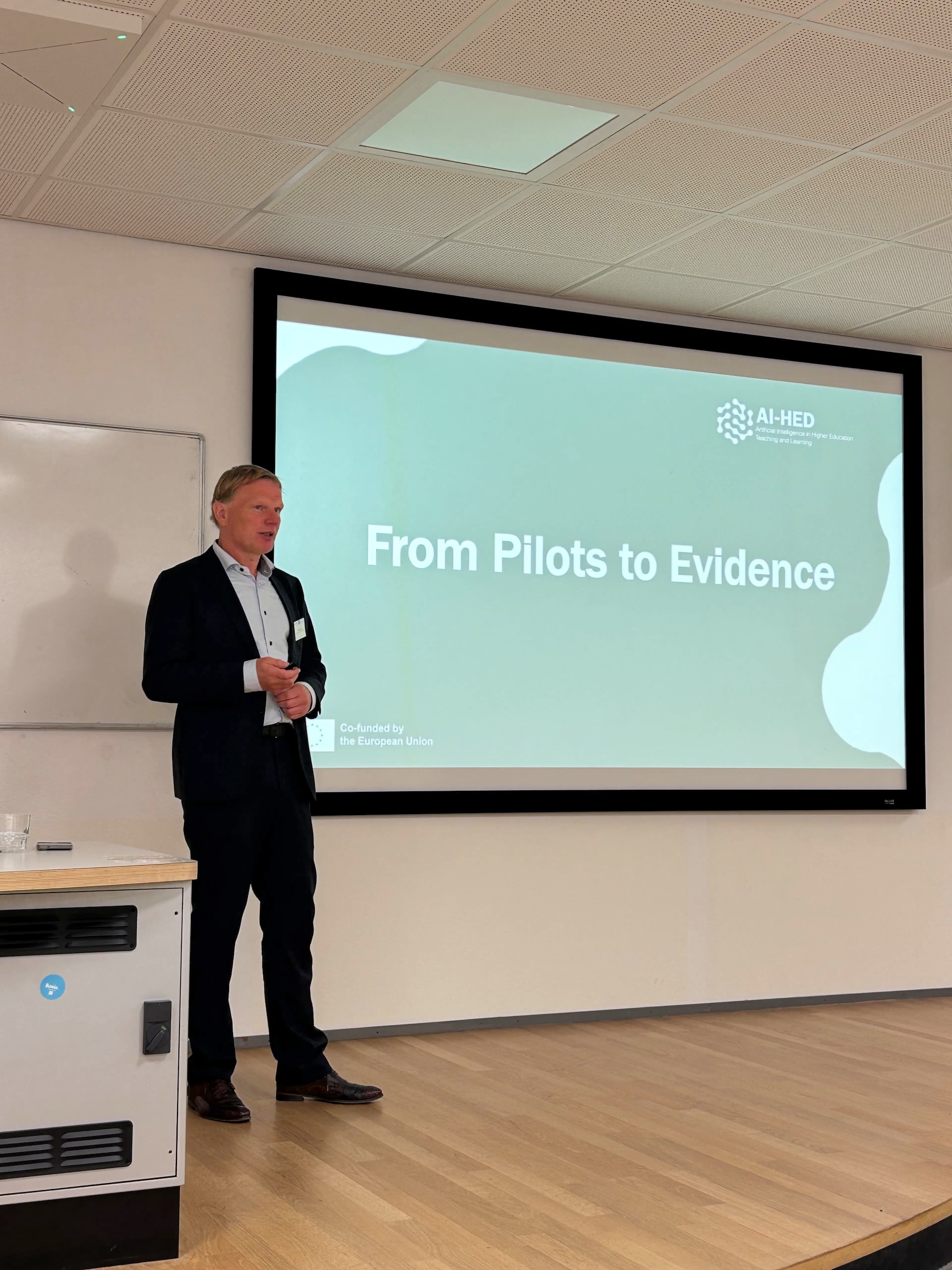
Erik Kostelijk (AUAS) then introduced the AI-HED project, presenting its objectives, activities and key findings.
His presentation, “What the AI-HED Pilots Teach Us”, highlighted the outcomes of 24 AI-enhanced pilot courses involving more than 1,000 students across different disciplines. Through pre- and post-semester surveys, teachers’ logbooks and focus groups, the project explored how the deliberate integration of AI influenced students’ learning, educators’ practices and approaches to curriculum design and assessment.
The findings revealed encouraging developments. Students reported improvements in their AI-related digital competencies, confidence and ability to use AI in their learning. Educators also strengthened their competencies and increasingly recognised AI as a valuable tool to support their role as facilitators of learning. Notably, 70% of participating teachers would highly recommend integrating AI into education to their colleagues, while none expressed opposition.
However, the results also highlighted important challenges. AI can improve the quality of students’ outputs without necessarily ensuring meaningful learning. This raises fundamental questions about how to assess students’ actual competencies, maintain their ownership of the learning process and ensure that AI supports, rather than replaces, critical thinking and cognitive effort.
Drawing on these findings, Erik presented five key recommendations for higher education institutions: rethink educational models rather than simply add AI tools; build coherent AI competence development across study programmes; redesign assessment to make student learning visible; ensure equitable access to AI; and establish institutions capable of continuously learning and adapting to technological change.
The presentation reinforced one of the project’s central conclusions: moving from improvisation to effective AI integration requires not only technological innovation, but also pedagogical transformation and institutional commitment.
Read the full article | Watch the recording | Download the slides (PDF)
Best Practices
At the heart of the event were the experiences and lessons learned from the project’s pilot courses, implemented across four European higher education institutions in the Netherlands, Austria, Portugal and Croatia.
Four best practices illustrated how generative AI can be integrated into different disciplinary contexts:
1. Using an AI Persona as a Research-Informed Thinking Partner
Alexandra Benitez Burgos — AUAS, Netherlands
Alexandra presented how AI personas can support research-informed thinking, helping students explore different perspectives and strengthen their analytical and decision-making skills.
Watch the recording | Download the slides (PDF)
2. Designing Smart Assignments for Productive AI Use in Learning
Friedrich Stallinger — UAS for Business & Society, Austria
Friedrich explored how to design assignments that encourage productive AI use while maintaining students’ active engagement, critical thinking and responsibility for their own learning.
Watch the recording | Download the slides (PDF)
3. AI-Assisted Multiplatform Storytelling: From Written News to Short-Form Video
Vera Moutinho — ESCS-UPL, Portugal
Vera demonstrated how generative AI can support multiplatform journalism education, helping students transform written news into short-form video while preserving human creativity, editorial judgement and critical oversight.
Watch the recording | Download the slides (PDF)
4. AI-Supported Digital Marketing: Teaching Critical Evaluation
Magdalena Kuštelega — FOI - University of Zagreb, Croatia
Magdalena shared how AI was integrated into digital marketing education, with particular emphasis on developing students’ ability to critically assess AI-generated content and make informed professional decisions.
Watch the recording | Download the slides (PDF)
Together, these examples highlighted a central message of AI-HED: the value of AI in higher education depends not simply on the technology itself, but on how it is integrated into pedagogical practices, learning objectives and assessment.
Want to explore the AI-HED Best Practices in more depth?
Discover how AI was integrated into real teaching and learning contexts, explore the pedagogical approaches behind the pilot courses, and find inspiration for your own teaching practice.
Explore the AI-HED Best PracticesTurning insights into practice: interactive workshops
The afternoon continued with five interactive workshops, offering participants opportunities to explore practical approaches to AI integration in higher education.
The workshops addressed different dimensions of AI-enhanced education:
- GenAI: How do we assess? — Erik Kostelijk and Raúl Casado Linares (AUAS).
- Staying AI-HED: Innovating Teaching & Curricula — Dietmar Paier (UAS for Business & Society).
- Knowledge Management and Research with AI — Bruno Amaral (ESCS-UPL).
- Generative AI for Educators: Adapting, Creating and Reflecting — Larisa Hrustek, Iva Gregurec, Magdalena Kuštelega and Matija Šajn (University of Zagreb – FOI).
- Generative AI for Educators: Adapting, Creating and Reflecting (Online) — Bogdan Okreša Đurić (University of Zagreb – FOI).
These sessions connected the project’s findings with the everyday challenges faced by higher education educators, encouraging reflection, experimentation and the exchange of practical approaches.
What does it take to become an AI-ready university?
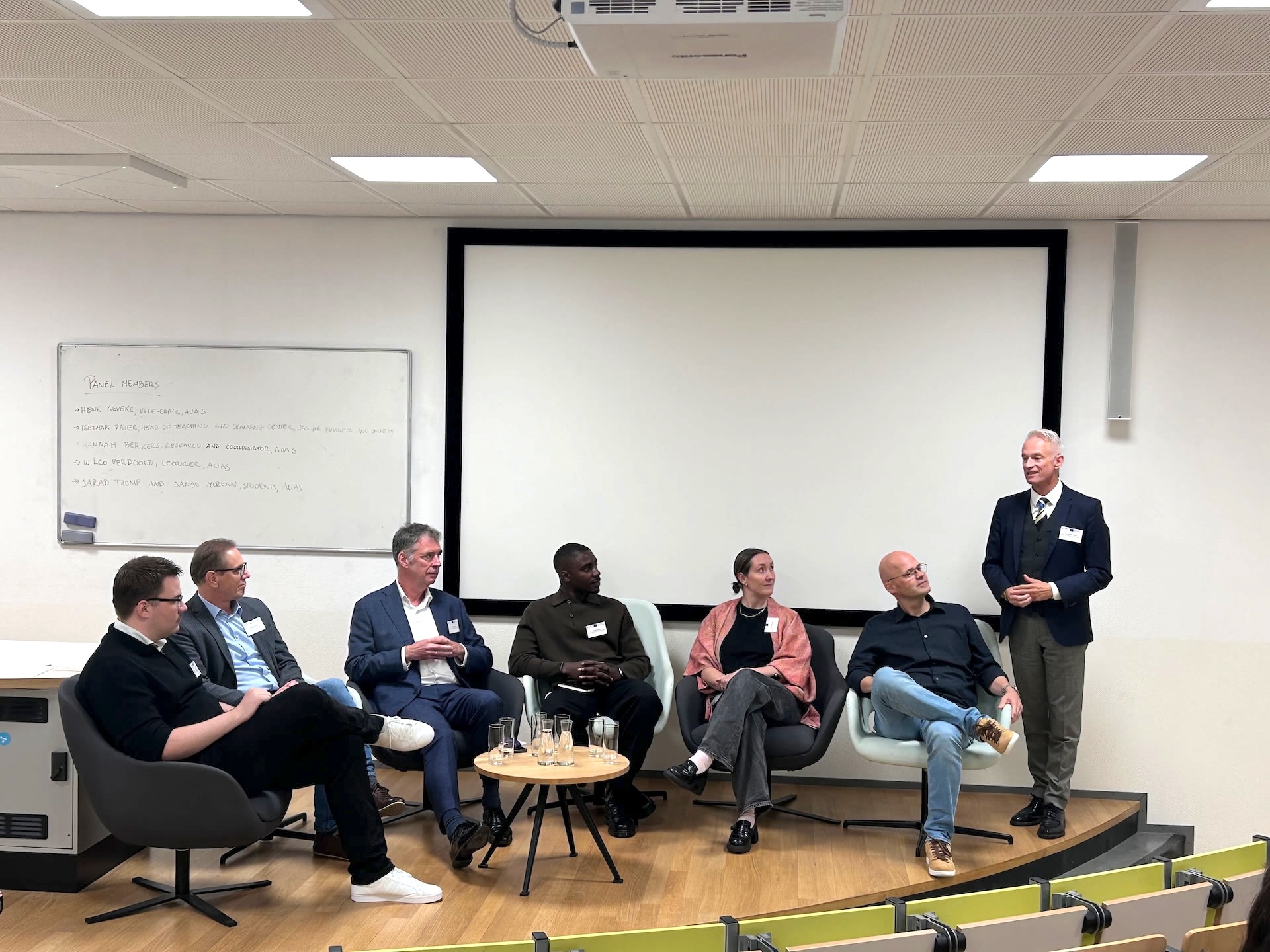
The event concluded with a panel discussion entitled “The AI-ready university: What does it take?”, moderated by Erik Kostelijk (AUAS), bringing together institutional leaders, researchers, educators and students to reflect on the future of higher education in an AI-driven world: Henk Geveke (Vice-Chair, AUAS Executive Board), Dietmar Paier (Head of Teaching & Learning Center, UAS for Business & Society), Hannah Berkers (Researcher and Coordinator, AUAS), Wilco Verdoold (Lecturer, AUAS) and Jarad Tromp (Student, AUAS).
The discussion highlighted that becoming an AI-ready university is not simply about adopting new technologies, but about fundamentally rethinking teaching, learning, assessment and the competencies students need for their future professional lives. Participants emphasised the importance of developing critical thinking, professional judgement and the ability to make informed decisions about when, why and how to use AI, while maintaining human agency and avoiding excessive dependence on technology.
Student perspectives reinforced the need for higher education to adapt more quickly to technological developments and to provide structured opportunities to develop AI competencies. The discussion also addressed the importance of equitable access to AI tools, continuous professional development for educators and more meaningful collaboration between teachers and students.
A central message emerged: AI integration should be guided by human needs, educational purposes and institutional values, rather than by technology itself. Building an AI-ready university requires a shared vision, collaborative experimentation and a commitment to ensuring that AI enhances the quality of education, meaningful work and human development.
Read the full article | Watch the panel discussion
Couldn’t attend? Explore the resources available
The conversation does not end with the event.
Whether you missed the presentations, attended only part of the programme or would like to revisit a particular topic, the recordings of the main presentations and their slides are now available online.
Explore the project overview, discover four teaching practices, access the available workshop materials and revisit the panel discussion.
Explore the AI-HED Final Event: recordings, slides and programme
The AI-HED Final Event marked an important milestone in the project’s journey, bringing together insights from experimentation, evaluation and collaboration across institutions.
The next challenge is to turn these lessons into sustainable educational practices, ensuring that AI enhances human learning, critical thinking and the role of educators in shaping the future of higher education.